
Preston Norbury’s Story
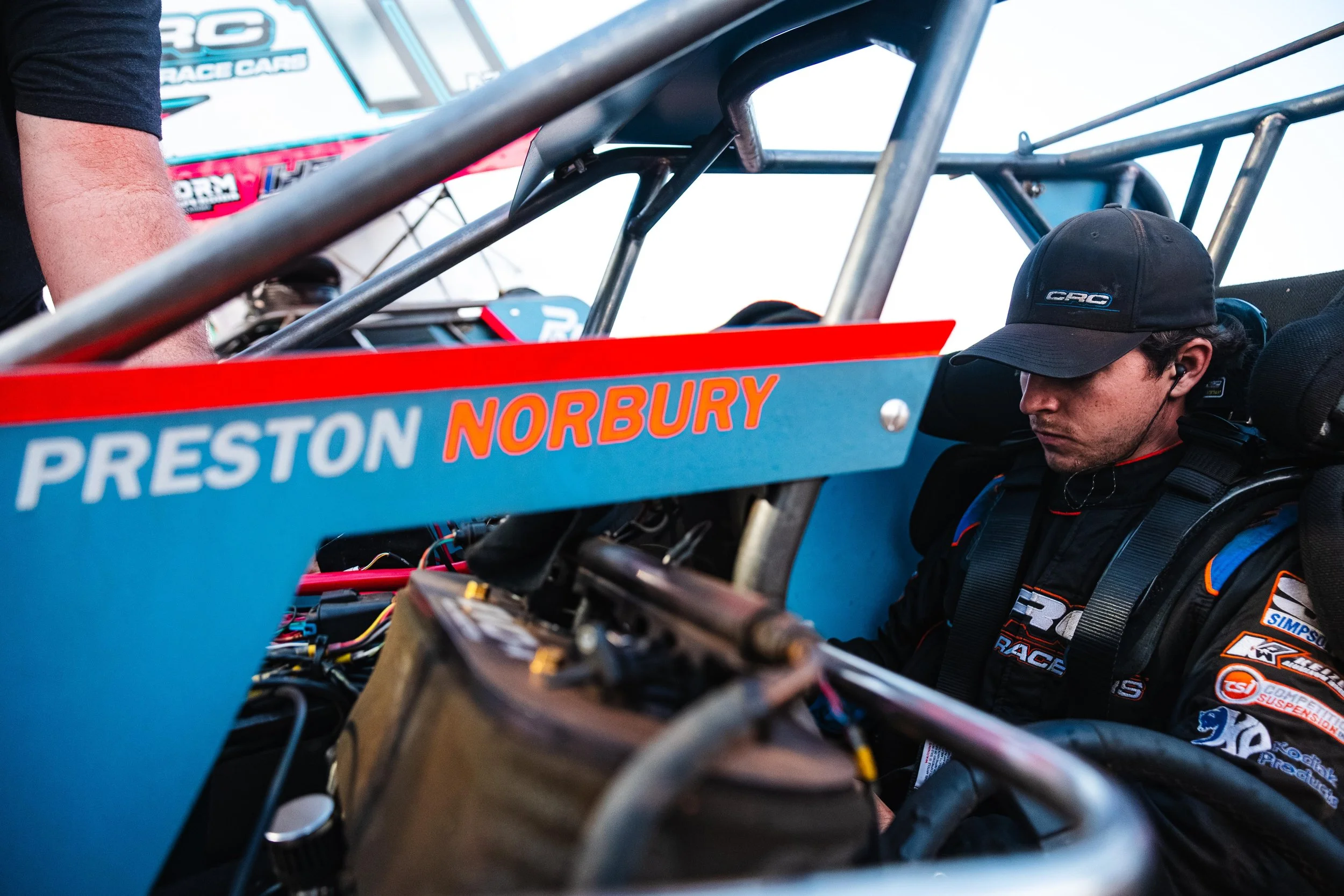
Racing has been part of my life since before I was born — and I mean that literally.
My grandfather was involved in racing. My dad grew up racing. By the time I came into the world, going to the races wasn't something our family did on weekends for fun. It was just life. It was the air we breathed. I grew up going to the dirt track.
My dad ran Prescott Valley Speedway, which meant I didn't just attend races — I lived at that place. That track was my playground, my classroom, and my second home all rolled into one dusty, loud, beautifully chaotic package. On race nights I carried the trophies from the storage container up to victory lane after every main event. I'd help my grandma sell pit passes at the gate — and I quickly learned that if you pressed the adhesive part of the wristband down right on your friends' arm hair when you stuck it together, you could get a pretty good reaction out of them. I thought that was absolutely hilarious. They did not always agree. I figured out pretty quick that the golf cart was basically a taxi service waiting to happen, and that some of the older guys didn't love the long walk back to their trailers after a race. Five bucks a ride. I was out there running a legitimate side hustle before I had any idea what a side hustle was. I'd wander the pits talking to drivers and crew guys and absorbing everything I could, even when I had no idea what I was absorbing.
One night they put me in charge of handing out raffle tickets. One per person — simple enough. Well. Some guy came up and offered me money for extra tickets. My rotten little ten-year-old brain did the math very quickly and decided that was a fine idea. Before long I had made more money than I'd ever seen in my life. I thought I was a genius.
One of the track managers noticed people had more than one ticket. I had to give every dollar back.
That week, like most weeks, I was out at the track helping get it ready for the next race night. Mostly that meant my dad got the track ready while I played in the dirt piles. Sometimes I'd help fill the water truck. Sometimes I'd get to drive the blade around and help roll in the surface. I didn't fully understand it at the time, but I was falling in love with everything about that place — the work, the smell of the dirt, the way the whole thing came together on race night. I just wanted to be part of it. All of it.
Ten Years Old and Absolutely Hooked
I had wanted a race car for as long as I could form a coherent thought. I'd watch those quarter midgets fly around the track and feel something in my chest that I couldn't quite describe — just this deep, certain knowing that that was what I was supposed to do.
When I turned ten, my parents made it happen.
They got me a black Stanley quarter midget with a blue frame. I can still picture it. The first time I got to drive it I didn't even have a race suit yet — had to borrow one that didn't fit right, wore my dad's helmet and his neck restraint. I looked like a little kid playing dress-up in his dad's clothes. I didn't care even a little bit.
My first race is something I will carry with me for the rest of my life.
I got to the lead. Got spun out. Had to go all the way to the back of the field.
And then I drove through the entire field and won. My first race ever. From the back.
When I pulled into the pits, my big tough guy dad — the guy who kept everything together, who never got rattled, who was always the steady one — was tearing up.
I was hooked. Completely, totally, permanently hooked. There was no version of my future that didn't involve this. I didn't decide to be a racer that night — I just finally understood that I already was one
Chuck, a Welding Hood, and a Very Late Night
Chuck and my dad grew up together. That means Chuck wasn't a fabricator we hired or a guy we found through a contact. He was family. He still is.
In 2014, my dad and Chuck decided we were going to start building our own quarter midget chassis. Looking back, that was the moment Coyote Race Cars was born.
I was eleven years old, just trying to be useful wherever I could. When we bent tubes, my job was to hold the end and keep it level. When we notched tubing on the hole saw, Chuck had to constantly tell me to step back because I was literally eye-level with the metal shavings flying off the bit. I thought I was helping. I was mostly just in the way with a lot of enthusiasm.
But I was obsessed. Every step of the process, I needed to understand why. Why does this tube go at this angle? What does changing this geometry actually do to the car? Why does this work and that doesn't? Chuck had endless patience for those questions, and he answered every single one of them.
For my high school graduation, he took me to the welding supply store and bought me a welding hood.
That was the gift. Not a card, not a check, not something I'd forget about in a week. A welding hood — because he knew exactly who I was and what I was going to spend my life doing. He sat down with me that day and showed me the basics. How to strike an arc. How to read the puddle. How to move. The kind of thing you can explain in an afternoon but only actually learn by doing it ten thousand times.
That night I stayed late in the shop by myself and just practiced. Over and over on scrap metal, running bead after bead, most of them ugly, slowly getting less ugly. I wasn't going to bed until I had something to show for it.
The next day, we had a car that needed to get finished. Chuck could only come out on Fridays and some weekends — he had a real grown-up job with real grown-up responsibilities. So the day after he taught me the basics, I just went for it. I got the whole car tacked together myself.
I cannot fully describe the feeling of standing back and looking at something you built with your own hands, knowing that yesterday you didn't know how to do that. It hit me somewhere deep. And it planted something in me that has never gone away — this constant hunger to add to the toolbox. To learn the next thing. To figure out what I don't know yet and go learn it.
That hunger is still there every single day.
Going All In
After I graduated high school, I stopped treating this like a hobby and started treating it like a calling.
I fell completely in love with the engineering side of it — not just building, but thinking. Thinking about why race cars do what they do. Why a change in the left rear spring rate makes the car feel different in the center of a corner. Why chassis geometry that works on a flat track falls apart on a banked one. The physics of it, the feel of it, the constant puzzle of trying to get ten things right at the same time when changing one of them changes all the others.
My dad was always good about giving me room to experiment. He let me try things with setup, with chassis geometry, with ideas that probably looked ridiculous on paper. And when those ideas didn't work — which they often didn't — he let me figure out why instead of just telling me I was wrong. That gift of being allowed to fail and learn from it is something I think about all the time now, especially when I'm working with young drivers.
The thing that truly opened everything up was learning SolidWorks.
With SolidWorks I could take something that only existed in my head and put it on a screen. I could test a geometry change without bending a single tube. I could look at a design from every angle, catch problems before they became expensive mistakes, and push ideas further than I ever could by feel alone. It sounds like a technical skill — and it is — but what it really gave me was permission to dream bigger. The only limit became the quality of the idea itself.
A Dorm Room, a 3D Printer, and a Plan That Wasn't Really a Plan
Preston Norbury Innovations started in my college dorm room.
Just me, a laptop, a 3D printer, and a head that wouldn't stop coming up with ideas for parts I thought other racers could use. I was printing things and selling them online. There was no grand business plan, no pitch deck, no five-year projection. It was just a racer who couldn't stop thinking about racing and needed an outlet for it.
But something was quietly building underneath all of it. And it really started to take shape when the Bohard family walked into my life.
Gas Station Food and No Regrets
In 2026, Tony gave us the opportunity to take the team on the NOW600 National Tour — one of the most competitive micro sprint series in the country.
I know how people imagine that. The open road, racing every weekend, living the dream. And it is all of that. But the version that doesn't make it into the highlight reel is also the version I love the most.
It's gas station food at one in the morning because that's the only thing open after you load the hauler. It's running on four hours of sleep because you were up prepping the car from the night before. It's driving the truck across the country to a track you've never seen, against drivers who've raced there a hundred times, and having to figure out in practice what they already know by memory.
That is genuinely my dream. Not the polished, filtered version — the real one. The gritty, grinding, occasionally miserable, completely exhilarating version of building something from nothing and refusing to stop.
We've struggled this year. Chasing setups at unfamiliar tracks, getting gearing wrong, making mistakes that cost us on race nights. But every single night out there we're a little bit better than we were the night before. The knowledge we're building can't be bought. You can't learn what we're learning by staying home. You have to go get it, and we are out there getting it every single weekend.
And the people I have around me make even the hardest nights worth it. That's not something you take for granted.
None of this would have been possible without people who believed in what we were doing and showed up for us in ways I will never forget.
The Tyre family opened their home to me while I'm out here on the road. They gave me a place to stay between race nights instead of just being a guy living out of a hauler. The thing that gets me is that before I showed up at their door, we had only talked a handful of times. They didn't really know me. And they welcomed me in anyway — completely, genuinely, without hesitation. That kind of generosity says everything about the kind of people they are.
The Miller family has been equally incredible. They let me keep my trailer at their property and work out of their place, which alone is an enormous contribution to making this whole operation function. But beyond the logistics, they roll up their sleeves and help me with the real work — keeping the trailer clean, getting the cars clean, all the unglamorous stuff that makes the whole program run. They have become some of my closest friends. At this point they feel like family.
And that's really what this whole thing is about. Yes, it's about racing. It's about building fast cars and developing great drivers and growing a brand. But underneath all of that, what I'm really building is a racing family. The relationships I'm forming out here — with drivers, with families, with people who open their homes and their lives to be part of something — those are the things I am most grateful for. Those are the things that last long after the checkered flag falls.
The Conversation That Changed Everything
Tony Bohard had bought a car for his son Skyler. They were brand new to dirt track racing — learning the whole world from scratch, figuring out everything as they went. They took the car home and ran it themselves for a race or two.
I watched and I noticed some things on the car that had been overlooked. Nothing catastrophic — just details. The kind of details that separate a car that's fighting you from a car that's working with you. So I walked up to Tony and said what I was thinking: why don't you let me take care of this car? Skyler is obviously talented. If we work together, I can take this off your plate, we'll have more success on the track, and I'll make sure that kid has every possible advantage I can give him.
Tony said yes.
That conversation changed the entire direction of my life.
For the first time, it wasn't just about me. I had a family trusting me with their son, their investment, and their dream. And I felt the weight of that — not in a bad way, but in the way that makes you sharper. How can I ask a driver to give me one hundred percent on the race track if I'm not putting one hundred percent into his setup in the shop? How can I stand in the pits and tell Skyler to try a different line if I can't run that line myself? That accountability changed how I approached everything.
It made me a better crew chief. And honestly — it made me a significantly better driver. Working with a young driver forces you to race with intention. You can't just go out there and make laps on autopilot when someone is watching everything you do and learning from it.
Not long after, Coyote Race Cars provided Annalesia Miller a car to race back in Oklahoma — putting our product on the track with another talented driver and expanding our brand at the same time. And now I had a real team — two development drivers, two families trusting me, and a program that was starting to look like something.
That's when the vision crystallized. I didn't want PNI to be a parts store that happened to go racing. I wanted it to be a real racing program — one that gives young drivers the same opportunity my parents gave me. The chance to actually learn. To understand the machine underneath them, not just how to point it at the corner. To fail in a safe environment and come out the other side faster and smarter for it.
I want PNI to be the place where careers start.
Midgets — The Family Discipline
If you want to understand my family, you need to understand how we feel about midget racing.
Midgets are my family's favorite discipline in open wheel racing. My dad ran midgets when he raced. In my opinion, a midget is where you really see the true talent of a driver come to life — they demand everything you have and then some.
My introduction to midget racing didn't start behind the wheel. It started in the pits, as a crew guy for my good friend Drake Edwards. Drake had gotten the opportunity to race the USAC Western States Midget Series and I offered to come help if he needed it. I'd never been around a midget before, never worked on one — I just knew I wanted to have that experience badly enough to show up and be useful.
So he let me tag along.
That year we traveled all over California. It was my real introduction to traveling to go racing — before that we primarily raced in Arizona at Adobe Mountain Speedway. We'd traveled a little, but nothing like this. And I thought it was just so cool that every single race was at a different track. You learn so much more when you're not running the same place with the same people week in and week out. Every new track is a new puzzle.
After that year helping Drake, my dad decided we were going to put our own car together. I was so excited — and I wanted to do something to thank him for everything he had done for me throughout my whole life.
When we dropped the car off to get wrapped, my dad thought it was going to come back in my usual blue and orange color scheme. But while he wasn't looking, I worked with the wrap guy on something different. When we picked it up, the car was black with neon pink scallops and silver leaf numbers — a tribute to one of my dad's old midgets.
My dad looked at it and his first reaction was confusion. It was pink, not orange, and he thought the wrap guy had made a mistake. He looked at me like he was about to say something. And then it clicked. Once he realized what it was and why I'd done it, he appreciated it more than I can describe. That moment meant everything to me.
Racing the midget made me a significantly better driver. They are just so different from anything I had ever driven before. The harder you drive a midget, the better it works — they want to be attacked, not managed. That philosophy, that way of thinking about a race car, carried over into everything else I do behind the wheel. It changed how I approach every car I get into.
We learned a lot at Chili Bowl this year, and we were able to pick up our first win in the midget at Placerville Speedway — something that really boosted my confidence. It's always the first one that's the hardest to get. Once you get it, you know you can do it. And after that, everything feels a little more possible.
The Green 77
There's one more chapter that has to be part of this story.
The Michaels family.
I work for their company — doing CAD work, running manufacturing equipment, the kind of hands-on technical work that keeps my brain in the same place it needs to be for building race cars. Everything feeds into everything else. But the job is only part of what the Michaels family means to me.
Growing up, I used to watch that green number 77 sprint car at the track and feel something. That car represented a level — a level I wanted to reach someday. I'd watch it race and think, quietly, to myself: one day.
Earlier this year, Bill gave me that day.
The first time I climbed into that car is burned into my memory. Bill sat me down beforehand and made something very clear: there was no pressure. Zero expectations. He believed in me completely and whatever happened out there, happened. The only pressure I would feel that night was the pressure I brought myself — and I brought plenty of it.
He put an incredible car underneath me. Gave me full freedom to set it up the way I wanted it. Did everything in his power to make sure I was comfortable. And from the moment I pulled onto the track, I was. Completely at home in a car I'd been watching since I was a kid.
Sometimes it still doesn't feel real.
The Michaels family were the first people outside of my dad who ever trusted me with a race car. The appreciation I have for Bill and for all of them is the kind that's hard to say out loud without it sounding like not enough. I am so grateful, and I am so excited about where this relationship is headed.
What's Next
We are launching a new chassis with Coyote Race Cars.
Everything went into this car. Every late night in the shop. Every setup experiment that didn't work and taught us why. Every conversation with a driver in the pits trying to find a tenth of a second. Every mile logged on the national tour learning what these cars need to be fast on tracks we'd never seen before. A decade of building, racing, failing, and figuring it out — all of it is in this chassis.
This isn't just a product launch. It's a marker in the ground. A line between what PNI has been and what it's becoming. The team is growing, the program is growing, and we are taking this whole operation to the next level.
I get asked sometimes why I do this. Why the sacrifice. Why the grind. Why not find something easier.
The honest answer is I don't know how to care about something halfway. I never have. When I love something I go all the way in — and I have loved racing and building race cars since I was old enough to understand what loving something means.
My grandfather raced. My dad raced. And now I'm out here trying to build something that outlasts me. Something that gives the next generation of drivers a place to grow, a team that believes in them, and cars built by people who race every single thing they sell.
We race what we build. We build what we race. And we are just getting started.